Compliance
Filter Maintenance: Baffle, Mesh, and Carbon Filters Explained
A practical guide to the three main types of kitchen ventilation filters — how they work, how to maintain them, and what TR19 Grease requires.

Bright Hygiene • 3 min read
Three Types of Filter, Three Different Jobs
Commercial kitchen ventilation systems use filters to manage the grease, smoke, and odours produced during cooking. The three main types — baffle, mesh, and carbon — each perform a different function, and understanding the differences is important for maintenance, compliance, and fire safety.
Baffle filters and mesh filters are both grease filters, designed to capture airborne grease particles before they enter the ductwork. Carbon filters (also called activated charcoal filters) serve a different purpose: they absorb odours and volatile organic compounds from the extracted air, typically installed further along the ventilation system where odour control is required.
Baffle Filters: The Industry Standard
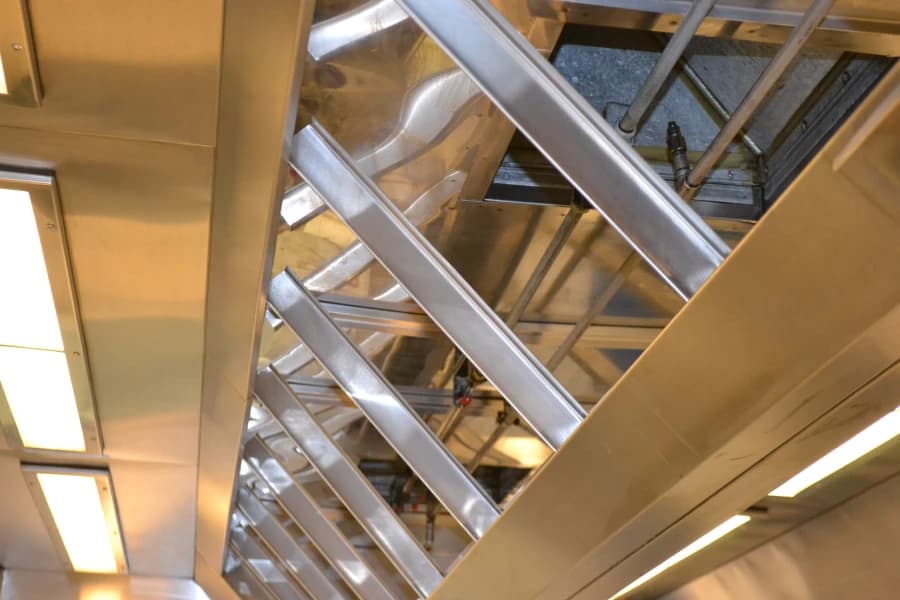
Baffle filters are constructed from interlocking stainless steel blades arranged in a chevron pattern. As grease-laden air passes through, it is forced to change direction multiple times. The rapid changes in airflow direction cause grease droplets to separate from the air stream and drain into a collection channel at the base of the filter.
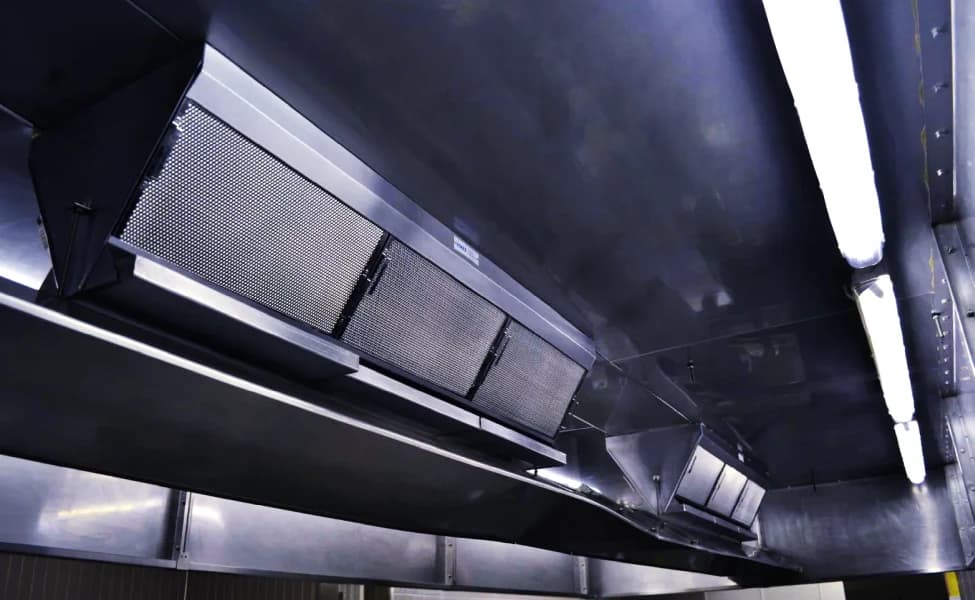
Baffle filters are recommended by TR19 Grease and current industry guidance for several reasons: they provide effective grease capture without significantly restricting airflow; they act as a flame barrier — with the interlocking blade design prevents flames from passing through into the ductwork; they are also durable and easy to clean, typically lasting several years with proper weekly maintenance. Cleaning of these filters can be carried out in a commercial dishwasher or by soaking in a professional degreasing solution.
Mesh Filters: Limitations and Risks
Mesh filters use layers of fine aluminium or stainless steel mesh to trap grease particles. While they are cheaper than baffle filters and still widely found in older installations, they have significant limitations. Mesh filters clog quicker than baffle filters, restricting airflow and reducing extraction performance. They are harder to clean effectively — the fine mesh traps grease within its structure, and over time the mesh becomes permanently saturated. Mesh filters can also degrade upon contact with strong cleaning agents.
Most importantly, mesh filters do not provide flame arrest. Flames can pass directly through the mesh into grease-laden ductwork beyond. TR19 Grease and fire safety guidance recommend that kitchens using mesh filters upgrade to baffle filters. If your canopy still uses mesh filters, this should be a priority consideration.
Carbon Filters: Odour Control
Carbon filters contain charcoal that absorbs odour molecules and certain volatile organic compounds from the air stream. They are used where kitchen odours could cause nuisance to neighbours or building occupants — particularly in city-centre restaurants, kitchens in shared buildings, or any installation where the discharge point is close to occupied areas.
Unlike baffle and mesh filters, carbon filters cannot be cleaned and reused. The activated charcoal becomes saturated over time and must be replaced. Replacement frequency depends on the volume and type of cooking — typically every 3 to 6 months for busy kitchens. A saturated carbon filter provides no odour control and can itself become a source of unpleasant smells if not replaced on schedule.
Maintenance Schedules and Filter Exchange
All grease filters should be cleaned at least weekly — more frequently in high-output kitchens. Between professional deep cleans, kitchen staff should remove, clean, and replace filters as part of their routine maintenance. Damaged or warped filters should be replaced immediately, as they cannot perform effectively and may create gaps that allow unfiltered grease into the ductwork.
At Bright, we offer a grease filter exchange service that takes the hassle out of filter maintenance. We deliver clean, ready-to-use filters on a scheduled cycle and remove the dirty ones for professional off-site cleaning. This ensures your filters are always in optimal condition, your kitchen staff are freed from a time-consuming task, and your system maintains peak extraction performance between professional cleans.